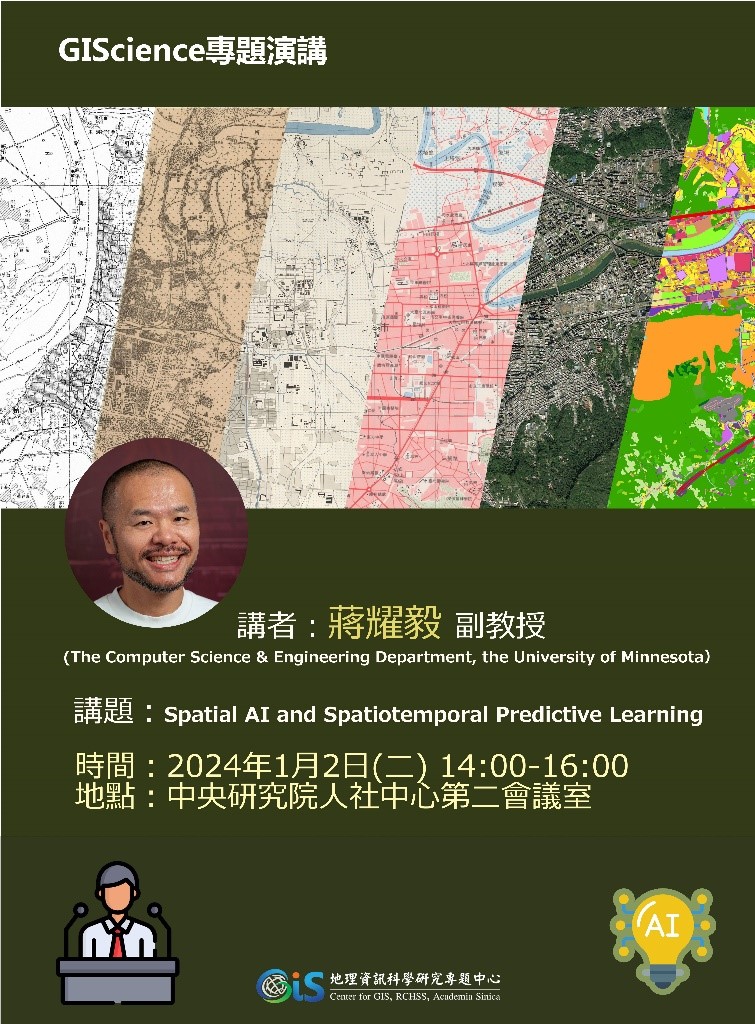
時間:2024 年 1 月 2 日(星期二)14 時至 16 時
地點:本院人文社會科學研究中心第二會議室
講者:蔣耀毅副教授(The Computer Science & Engineering Department at the University of Minnesota)
內容:
Knowing what has happened, where and when, and how it has changed over space and time is the key to modeling complex spatiotemporal phenomena and understanding how humans depend on, adapt, and modify them. Today, many disciplines produce and use an increasing volume of data containing location and time information, either explicitly, e.g., mobility data, air quality data, satellite imagery, or implicitly, e.g., scanned historical maps and text documents. However, the substantial heterogeneity in these data and inconsistencies in their spatiotemporal scales often result in existing analytic methods focusing on a few data sources and treating the space and time dimensions as an afterthought, limiting their capability to solve critical problems. This talk will present recent highlights of our research results in Spatial Artificial Intelligence. The talk will first present our recent physics-enabled machine learning methods leveraging spatial science theories for spatiotemporal predictions. This talk will also outline our ongoing research directions in Spatial AI and interdisciplinary impact in public health, transportation, national security, geography, history, library, and digital humanities.