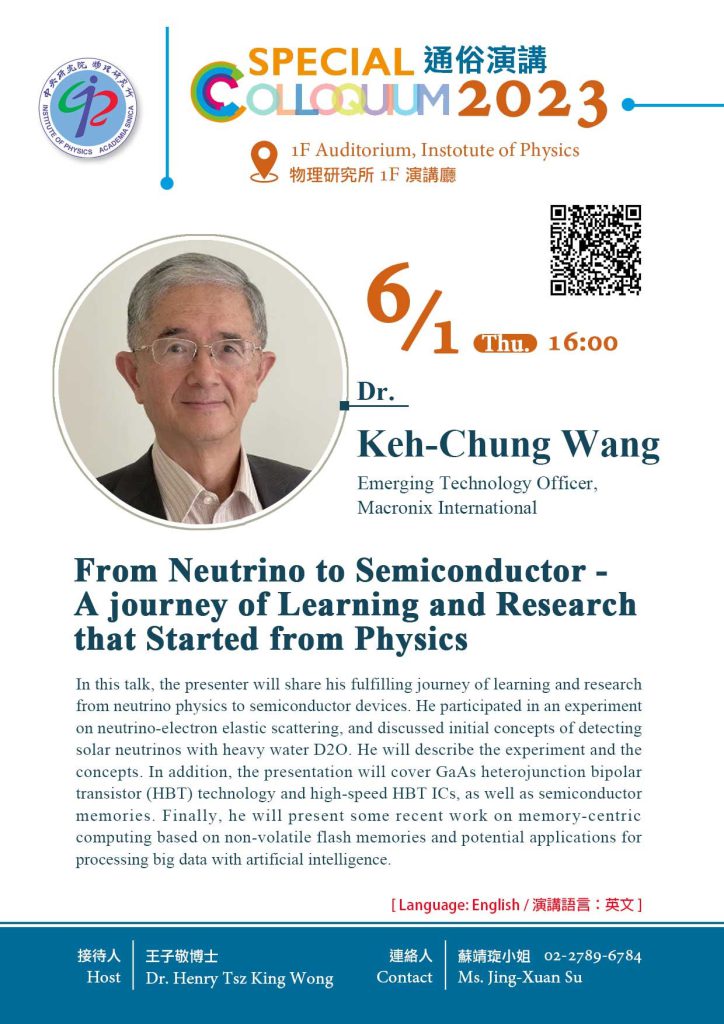
時間: 2023 年 6 月 1 日(星期四)16 時至 17 時 30 分
地點: 本院物理研究所 1 樓演講廳
主講人: Dr. Keh-Chung Wang(Emerging Technology Officer, Macronix International)
主持人: 王子敬特聘研究員(本院物理研究所)
活動網址: https://indico.phys.sinica.edu.tw/event/71/page/144-joint-colloquium-dr-k-c-wang
聯絡人: 蘇靖琁,(02)27896784,jingxuan@sinica.edu.tw
內容:
In this talk, the presenter will share his fulfilling journey of learning and research from neutrino physics to semiconductor devices. He participated in an experiment on neutrino-electron elastic scattering and discussed initial concepts of detecting solar neutrinos with heavy water D2O. He will describe the experiment and the concepts. In addition, the presentation will cover GaAs heterojunction bipolar transistor (HBT) technology and high-speed HBT ICs, as well as semiconductor memories. Finally, he will present some recent work on memory-centric computing based on non-volatile flash memories and potential applications for processing big data with artificial intelligence.
講者介紹:
Dr. Keh-Chung Wang received a BS degree in physics from National Taiwan University and a PhD degree in physics from California Institute of Technology. He is currently the Emerging Technology Officer of Macronix International Corp., responsible for emerging R&D in memory technologies and system applications. Before joining Macronix in 2015, he worked at Rockwell, Conexant, OpNext, HRL, UMC, and ASTRI. He has 38-year experience in electronic device research, IC design, and management. He and his colleagues at Rockwell pioneered development of GaAs HBT technology and transferred it to production. The technology has been used broadly for microwave power amplifiers in cell phones.
Dr. Wang is an IEEE Life Fellow. He was a recipient of Rockwell’s 1994 Engineer of the Year Award and 1995 Chairman’s Team Award. He was a guest editor of Journal of Solid-State Circuits. Dr. Wang co-authored more than 200 journals and conference papers in the areas of physics, electronic devices, circuits, and systems.
Dr. Wang researched experimental nuclear and neutrino physics at Caltech and UC Irvine during 1975-1985. In particular, he was a member of the neutrino experiment group at Irvine in the 1980s with Prof. Herbert Chen. The team formulated a novel solar neutrino detection concept at its embryonic stage, which would evolve to become the SNO experiment (Nobel Prize in Physics, 2015).